Texas is the largest title insurance market in the United States by premium volume.According to the American Land Title Association, Texas generated over $600million in title insurance premiums in 2023 alone — the highest of any state in the country.
For mortgage professionals, real estate brokers, and entrepreneurs looking to enter the title industry, Texas offers a combination of market size, transaction volume, and a clear regulatory framework that makes it a compelling entrypoint. TitleEase is fully licensed as a Title Agency with the Texas Department of Insurance, which means we can guide franchisees through the Texas-specificprocess from end to end.
This post covers what you actually need to know: the regulatory structure, the real costs, and an honest timeline.
Texas is one of a small number of states that operates under a “title plant” system and uses state-promulgated (government-filed) title insurance rates. This means:
• Title insurance premium rates in Texas are set by the Texas Department of Insurance, not negotiated between companies and consumers.Every licensed title company charges the same rate for the same policy in the same county.
• Texas title companies are required to either maintain or have access to a title plant — a database of recorded property records for the counties in which they operate. This is a significant infrastructure requirement that TitleEase addresses through its underwriter relationships.
• Title agents in Texas must be appointed by a licensed title insurance company (underwriter). This appointment process has its own timeline and requirements.
Understandingthese Texas-specific mechanics before you structure your entry into the market saves significant time and avoids costly structural mistakes.
To operate a title insurance agency in Texas, you will need:
1. Title insurance agent license from the Texas Department of Insurance
The responsible officer of the agency must hold or obtain a title insurance agent license. If you do not currently hold this license, TDI administers an examination and application process. Preparation time varies, but plan for 4–8 weeks from application to license issuance under normal processing conditions.
2. Underwriter appointment
Yourtitle agency must be appointed by a licensed title insurance underwriter authorized to do business in Texas. This is a separate approval process fromthe state license. Underwriter appointments typically take 3–6 weeks and require a review of your business plan, ownership structure, financial position, and RESPA compliance documentation.
3. Title plant access
Youragency must have access to a title plant for every county in which you intend to write title insurance. Plants can be accessed through your underwriterrelationship or through independent title plant providers. TitleEase’s underwriter relationships include plant access as part of the franchise system.
4. Errors &Omissions insurance
Texas requires title agencies to maintain E&O coverage at a minimum of $250,000per occurrence. Application and binding typically takes 1–2 weeks.
5. Surety bond
Asurety bond is required. The amount is determined based on your agency’s anticipated escrow volume. Standard bonds range from $25,000 to $100,000 and can be obtained relatively quickly once your other documentation is in order.
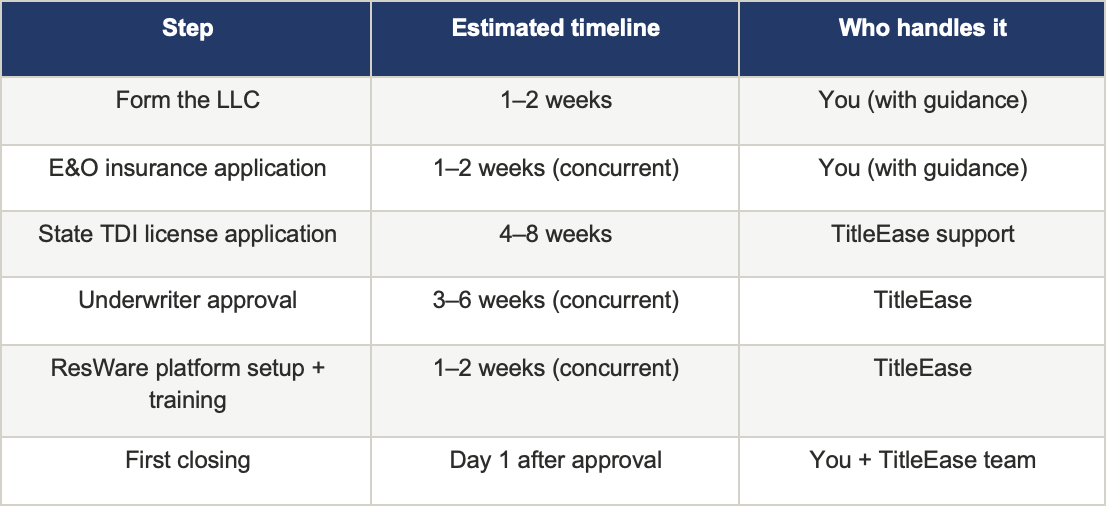
The most important structural insight in this timeline: most of these steps can run concurrently. The TitleEase process is designed to parallel-path these work streams rather than sequence them, which is why our typical franchisee reaches first closing in 60–90 days rather than the 6–18 months a fully independent launch would require.
Honest cost transparency is something we believe in strongly. The cost to launch aTitleEase franchise in Texas includes:
• TitleEase franchise fee: contact our team for current pricing
• E&O insurance: approximately $3,000–$8,000 annually depending on coverage level
• Surety bond: approximately $500–2,500 annually depending on bond amount
• State licensing and exam fees: $200–$500
• Initial operating capital: recommended minimum of$50,000–$75,000 for first 6 months of operations prior to reaching profitability
Comparison point: building a comparable Texas title operation from scratch — independently sourcing underwriter relationships, title plant access, software, compliance infrastructure, and operational expertise — typically requires$200,000–$400,000 and 12–18 months before the first closing.
Texas represents one of TitleEase’s strongest markets. We are fully licensed with the Texas Department of Insurance and have guided franchisees through the Texas launch process across multiple metro markets.
If you’re a mortgage professional, real estate broker, or entrepreneur evaluating Texas title ownership, the single most useful first step is a direct conversation with our team. We can walk through your specific situation, existing referral volume, and target market in detail.
→ Call us at (877) 696-5462 or visit titleease.io to schedule that conversation.
TitleEaseLLC is fully licensed by the Texas Department of Insurance. This post is for educational purposes. Consult a qualified attorney for legal advice specific to your situation.