The question every real estate and mortgage professional eventually asks
If you’ve ever looked seriously at owning a piece of the title business that flows through your transactions, you’ve almost certainly encountered two options: a title company franchise or a joint venture. On the surface, they look similar.Both put you in the title business. Both allow you to capture revenue you’re currently referring out. Both are structured to comply with RESPA.
But underneath, they are structurally different in ways that matter over a five- toten-year horizon. This post breaks down exactly how — without the saleslanguage.
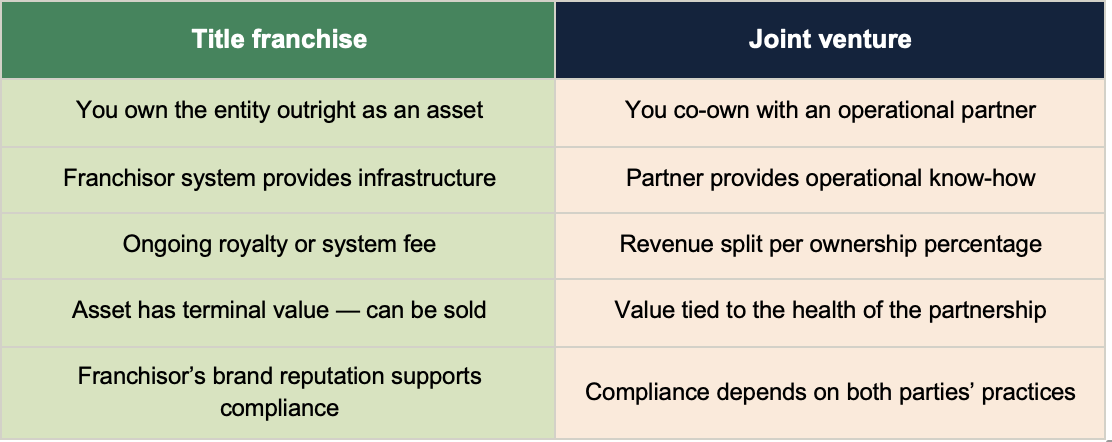
A title company franchise is a business you own. It’s typically formed as a limited liability company (LLC) in your name, licensed in your state, and operating under a proven system provided by the franchisor. You pay an upfront franchise fee and, in most structures, an ongoing royalty or fee in exchange for access to that system.
What“the system” actually includes varies by franchisor, but at minimum it should cover:
• State licensing guidance and application support
• Underwriter relationships and approval
• Title production software (such as Qualia) already configured
• RESPA compliance infrastructure and training
• Staffing models and operational procedures
The franchise is a tangible asset. It has its own enterprise value, meaning you cansell it someday. You are building something.
A title company joint venture is an agreement — usually formalized as an LLC — between two parties who co-own and co-operate a title company together. The most common structure pairs an existing title professional (who handles operations) with areal estate broker or mortgage lender (who contributes referral volume).Profits and losses are shared according to ownership percentages.
Joint ventures can be efficient. If the right operational partner is available, you can get into the title business quickly without building infrastructure from scratch.
The structural tension is this: the joint venture lives and dies on the relationship between the two parties. If the operational partner underperforms,changes strategy, or exits the relationship, your position in the business changes with them. You are co-owning a relationship as much as you areco-owning a business.
A frequently misunderstood point: neither structure is inherently more or lessRESPA-compliant than the other. Both can be structured as fully compliantAffiliated Business Arrangements (AfBAs) under RESPA Section 8(c)(4).
The key requirements apply equally to both:
1. The arrangement must be disclosed to the referred consumer before the referral
2. The consumer must be free to choose a different service provider
3. Returns must come from ownership interest, not referral activity
What afranchise structure does is make the compliance infrastructure explicit and documented by a franchisor whose reputation depends on getting it right. That is a meaningful operational advantage, particularly for professionals entering the title industry for the first time.
A title company franchise tends to be the better fit when:
• You want to own the business outright and build an asset with terminal value
• You don’t have an existing operational title partner you deeply trust
• You want a clear, documented compliance system from dayone
• You are entering the title industry without deep prior operational experience
• You have an existing, trusted relationship with an operational title professional
• The arrangement is structured as a genuine co-investment with aligned incentives
• You are comfortable with the long-term dependency on that relationship
The franchise model is not better for everyone. Neither is the joint venture model. The right question is: what do you actually want to own? If the answer is a business with standalone value that you control, the franchise structure is worth understanding in depth.
If you want to explore what a TitleEase franchise looks like for your specific situation, our team is happy to walk through it with you.
Ready to learn more? Contact TitleEase at (877) 696-5462 or visittitleeasefranchise.com.